

Normal functions of the kidneys
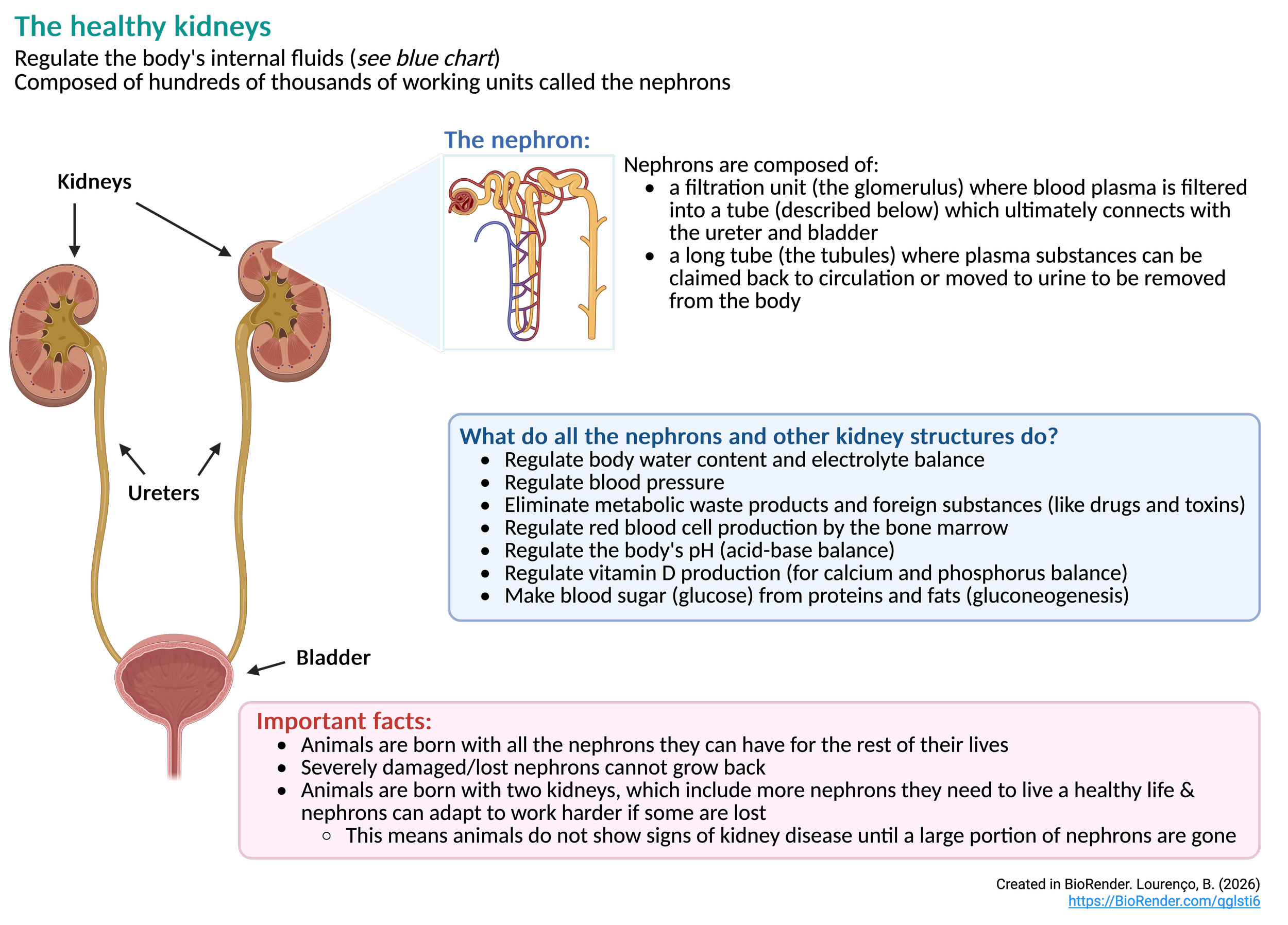

Most people know that the primary job of the kidneys is to clear waste products from the blood, but it also is important to know a little bit about how this is done, what else the kidneys do, and what happens when things go wrong.
The kidney is an organ made up of hundreds of thousands of functional units called nephrons (see diagram of a nephron on the left). Dogs and cats and people are born with as many nephrons as they will ever have and unfortunately, new nephrons cannot be produced. The good news is dogs, cats, and people have more than twice the number of nephrons needed for adequate kidney function and that’s why people with healthy kidneys can donate a kidney and still live normally. Each nephron is composed of a little filter called the glomerulus (plural = glomeruli) and a long passageway beyond the glomerulus called the tubule. All the tubules from each nephron eventually converge to form a collecting system that brings the waste products as urine to the bladder. As the heart beats, pressure within the small blood vessels of the glomeruli causes blood to be filtered. The filtrate consisting of water and small substances (such as sugars, amino acids, electrolytes, small proteins, and waste products) is forced into the tubules while blood cells and larger proteins remain in the blood. Think of the glomerulus as a spaghetti strainer. When water, salt and spaghetti is poured into the strainer, water (the liquid portion of blood known as plasma) and salt (electrolytes within the plasma) freely pass through the strainer, but the spaghetti (blood cells and proteins in the plasma) are retained. Then, as the filtered fluid flows down the tubules, the kidneys return water and substances the body needs back to the blood stream and allow the waste products and any excess water to go out into the urine. In terms of volume, more than 99% of the fluid that is filtered is returned to the blood and less than 1% is excreted. The famous kidney physiologist, Homer W. Smith once said, "Superficially it might be said that the function of the kidneys is to make urine; but in a more considered view, one can say that the kidneys make the stuff of philosophy itself." This was an eloquent way of saying that the kidneys are more concerned with what they retain in the body than what goes out in the urine. The real job of the kidneys is to regulate and keep stable the volume and composition of the body's internal fluids after the blood has been filtered through the glomeruli. For example, when you exercise and perspire, your kidneys will conserve body water by producing a small amount of concentrated (dark yellow) urine. If you were to drink lemonade to excess and overhydrate, your kidneys would excrete the excessive body water by producing a large volume of dilute (almost clear) urine. The urine the kidneys produce is merely a by-product of that process of conservation. The kidneys also have some other important functions such as producing a hormone (called erythropoietin) that stimulates red blood cell production by the bone marrow and modifying vitamin D derived from the diet into its final active form (called calcitriol) involved in both calcium and phosphate balance in the body.
The most common form of kidney disease in dogs and cats comes on very slowly over time is known as chronic kidney disease (CKD) and is caused by loss of nephrons. If any portion of the nephron is irreversibly damaged, the nephron ceases to function and is replaced by fibrous scar tissue. CKD is often progressive and by the time the disease is advanced, the kidneys can be so altered by scarring and inflammation that it can be nearly impossible to determine what exactly initiated the disease process. In his classic textbook, "Clinical Nephrology," Solomon Papper offered the following quotation from the American pathologist, Simeon Burt Wolbach to make this point: "It is often difficult to ascertain the nature of the building that has burnt down from a study of the ashes." Unfortunately, because dogs and cats cannot tell us how they feel, kidney disease often is very advanced (greater than three quarters of the nephrons have been lost) by the time it is recognized by pet owners and veterinarians.